SaaS Pricing Strategy: The 10x Rule

First thing to clearly understand when developing your SaaS pricing strategy; pricing is a function of Marketing.

If you think creating your SaaS pricing strategy is a function of Finance, Accounting, Operations, or even Sales… you’re doing it wrong.

That means anyone who comes up with a price for their app (or for your app) as the result of a spreadsheet function is doing it wrong.

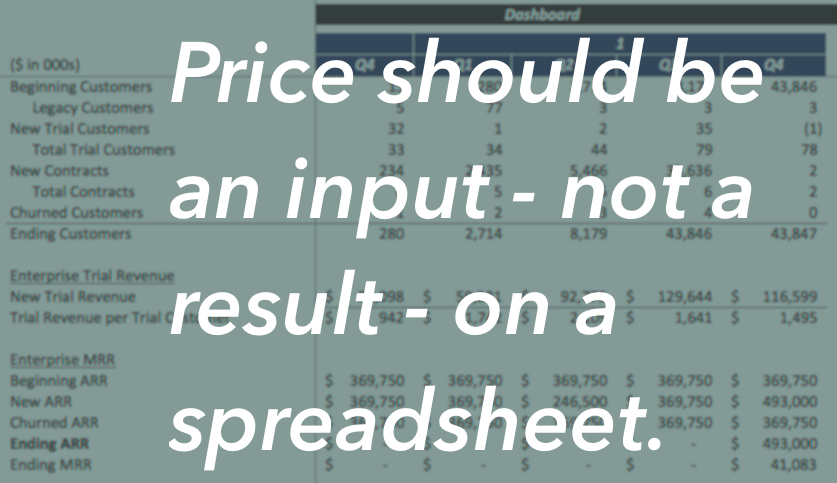
The spreadsheet shouldn’t tell you what your price is… your price should be something you put into the spreadsheet that will determine revenue and allow you to calculate future growth, profitability, etc.

Price should be an input, not a result, on a spreadsheet.

Second thing to clearly understand:

No one knows what the best price for your SaaS offering should be.

This is why most ‘Pricing experts‘ like to deal with companies that sell commodity products – including traditional software – in markets driven (downward) by pricing.

Value Pricing a SaaS offering, on the other hand, is a completely different beast where you’re often dealing with a completely new and/or heavily differentiated value proposition and very often – with entirely new categories of service offerings!

All we can do is get it AS RIGHT AS POSSIBLE out of the gate and understand that pricing is not a “set it and forget it” function, but – just as your overall Marketing Strategy is ever-evolving and changing with market forces, market feedback, etc.

Now there are techniques, tricks, voodoo dances, and smoke-n-mirror performances one can employ while coming up with your initial price that can help you get closer to that ‘getting it as right as possible.’

SaaS Pricing Strategy: Consider the Customer First

But let me be very clear; any techniques/strategies that don’t take the CUSTOMER into consideration as the main input when developing a price is not going to get you close to where you need to be.

There are so many ways to mess up pricing that the chances of you getting it close to right are not in your favor, even if you employ many of the tricks of the trade.

Fortunately, I don’t employ many of the tricks of the trade… I think ‘the trade’ gets most things wrong so why would I employ their tricks?

But I want to help you get your pricing as right as possible so you don’t leave money on the table… or not too much, at first.

Lead with Value for a profitable SaaS Pricing Strategy

Look, it’s easy to sell cheap stuff… higher prices actually require you to know your customer better!

Remember that customers generally care ONLY about the outcome and how it affects them (at least when they are searching for a solution).

This means – at first – don’t emphasize features – emphasize OUTCOMES – RESULTS – SUCCESS.

So the definition of Value Pricing is: Applying a price to a service that is congruent with the value derived from the services’s use rather than the underlying cost to create and deliver the SaaS, market prices, specific margins, etc.

Which makes Value Pricing the most effective method of pricing for SaaS and Web Apps… something like cost+margin just doesn’t make sense.

The key to Value Pricing is knowing the, well, value of your service as perceived by your target market AND/OR market segments (not all are alike).

Value is the “What’s In it For Them?” – WIIFT – of your SaaS.

It is the benefit of the benefit of the features… or the emotional benefit

So a very good way to determine your price point – because it requires you to really understand the customer – is to follow the 10x Rule.

We charge this much because our customers get at least 10x that much value.

If I sell something for $100, I want to provide at least $1,000 in value to them… at least.

Even better is if the “value” isn’t something that is ‘ROI-able,’ but rather something intangible that they cannot directly quantify.

You do this by understanding your customer’s goals, opportunities, problems, etc.

You do this by offering Price Anchors that are not competitive services, but what it would take to replicate this in-house, with low-efficiency, high-cost human beings, what you (or the industry) has paid to create this solution, or the fear of not meeting some level of compliance and the costs associated with that.

And you can remind them – maybe not in so many words – that you must charge a premium price so you have a large enough margin to provide an extraordinary value & experience!

But don’t just remind THEM of that… remember that yourself… charge a premium so you can offer truly PREMIUM service!

Using this method to determine a price will become clear quickly, and you’ll see that delivering a 10x ROI – even if simply perceived by the customer – is rather easy.

In fact, once you start doing this, you’ll see how it can be true that if you charge too little, a 10x ROI isn’t that exciting and how a low price could actually reduce your credibility in the market.

Let’s Optimize your SaaS Pricing Strategy

If you’ve been in-market at least 6 months and are curious how we could Accelerate your Profitable Growth – perhaps by optimizing your SaaS pricing strategy – email me and we’ll setup a time to discuss your options for moving your company forward.

- Lincoln

Display a Phone Number to Increase Conversions?

Does displaying a Phone Number on your website Increase Conversions?

I’ve been talking about Trust Factors and their effects for years and as I’ve done more work in this area others have taken an interest, too.

For instance, LessAccounting got a 2% lift in paid conversions they were able to correlated directly to adding a phone number to their marketing pages.

10 little characters added to their site bumped conversions 2%.

But what about Flowr’s non-result as documented in this KISSMetrics post?

Well, it’s simple… if you have a Free Trial that isn’t designed to convert prospects to customers, simply adding a phone number will probably not help increase conversions directly.

Just to be sure, I signed-up for Flowr, went through the whole process, and it is missing some key elements that are present in high-converting Free Trials.

So, if you have a product that is bad, not wanted, or otherwise positioned or promoted wrong, adding a phone number will probably not help increase conversions directly.

But… if everything else is good, a phone number – certainly in B2B, and especially where the SaaS or Web App vendor will be a major part of the customer’s business, will require integration, etc. – can really help.

In fact, this question of whether to add a phone number to your marketing website came up – interestingly – with a telco API company.

Being primarily an API company and selling to software developers means that most/all of their customers will heavily integrate with them and that means having a prominent phone number will certainly help.

That said, where I’ve seen a phone numbers help the most isn’t by increasing conversions directly, but by the conversations that occur when people call you.

I know for many companies, especially small ones or early-stage startups, the last thing you want to do is talk to a bunch of potential customers,… I’m sorry, but there’s your first problem.

Anyway, some of the people who call will be ready to buy or almost ready and talking to you – a real person – might just close the deal. Score.

But… most of the people that call might not even be interested (yet) in becoming a customer, but what they’ll tell you is what’s not clear on your site.

They’ll ask questions that you didn’t even think about, they’ll tell you they thought your product did x, y or z, and it will blow you away.

Those will be super-valuable conversations from which you’ll learn what to fix on your market site that WILL lift your conversion rate over time.

At least right now, and especially in B2B, some of your potential-customers will be more willing to pick up the phone and call you than to email (because you might spam them) or do the on-site chat thing.

So give them the opportunity to do that by putting a phone number on your site.

Here’s a quick hack, especially if you aren’t in the U.S. but want a U.S. number: just get a Google Voice number and have it go straight to voice mail at first (be sure to manage expectations and follow-up promptly).

Later you can switch to something more substantial, or use an answering service (you can just forward Google calls to that service when you aren’t in the office).

The reality is, most people won’t call, but it will give peace of mind to many.

But some will call and they’ll teach you things you never knew!

And as for where to put it on your site… while there are no standards, a phone number prominently displayed in the upper right corner of your site (in a header graphic or menu bar) seems to work well.

And do it on every page, too… you might have some information on a page that you don’t think is as “important” as the main page, pricing page, etc. but when your prospect is on that “non-important” page and something is confusing, having a phone number right there for them to see and take action is a good thing.

But definitely display the phone number above the fold and make it very easy to see… To me, this is one of the things that might have contributed to Flowr’s non-result; it was above the fold but very small and hard to read!

If you’ve been in-market at least 6 months and are curious how we could Accelerate your Profitable Growth – perhaps by optimizing your Pricing Strategy – contact me and we’ll setup a time to discuss your options for improving and accelerating customer acquisition.

Lincoln
(972) 200-9317

SaaS Affiliate Marketing: How-To Supercharge Your Growth

I’ve been asked if you can “quick start” a new venture or reinvigorate an existing offering with SaaS affiliate marketing?

Here’s the answer I generally give… “it depends.”

Okay, let me dig in a little deeper.

SaaS affiliate marketing can really super-charge your growth, BUT if you don’t have everything in alignment (or your ducks in a row), you won’t super-charge anything!

Think of it like this… if you have a super-charger and no engine to put it on, the super-charger doesn’t really help, right?

For SaaS affiliate marketing to work, you have to:

  • Be clear about your target audience
  • Have your value prop super-powerful and targeted to that audience.
  • Ensure the rest of your marketing is on target for that audience
  • Make sure your Free Trial is optimized, especially to keep affiliates interested if you pay only on conversions!

Not to mention your Pricing Strategy, landing pages, sign-up process, etc.

Plus you have to have a way to manage and communicate with your affiliates, keep them excited and above all… ensure they get paid for  what they bring and get paid on time… every time.

The SaaS Affiliate Marketing Catch-22

The pushback I often get from that is “if I do all that, I might not need affiliates”… which is correct.

You don’t *need* a super-charger on your engine – the engine will get you down the road – but the super-charger makes you go FASTER… which is awesome.

I suppose that analogy could play out fast, but the bottom line is, you can waste a lot of time/money/resources chasing affiliate marketing too early when your time might be better spent optimizing your base first.

Put another way… if you don’t know what you’re selling or to whom, it will be hard for others to sell it for you!

Curious how we could Accelerate your Profitable Growth – including by creating or optimizing an Affiliate Program for you? Contact me and we’ll setup a time to discuss your options for improving and accelerating customer acquisition.

Lincoln
(972) 200-9317

SaaS Affiliate Marketing: Your Virtual Salesforce

One benefit of SaaS Affiliate Marketing is knowing exactly what your Customer Acquisition Cost (CAC) will be!

Whether you’ve considered creating an affiliate marketing program for your SaaS or Web App – or not – or even if you currently have one, you NEED to watch my interview with Jack Born.

BTW, here are three vendors that will allow you to easily offer and manage an affiliate program for your SaaS or Web App:

Leveraging a massive SaaS Affiliate Marketing salesforce

Do you prefer to listen on the go? Download the .mp3 audio file (29.1MB) here.


The awesome folks at Wistia hooked me up with premium business video hosting!

Think of SaaS Affiliate Marketing as Leverage

I’ve wanted to get Jack in front of you for… well, since I met him because what he knows about Affiliate Marketing can absolutely change your SaaS or Web App business.

Jack is the king of Affiliate Marketing and he shares a TON of awesome information with us about how to get a MASSIVE online Salesforce working to send you customers.

Did you know companies like AWeber, Evernote, Loop11, BigCommerce, SuccessFactors, LessAccounting, SurveyGizmo, and Unbounce are leveraging the power of the affiliate sales channel to accelerate sales right now?

So there’s got to be something to it, right?

But in my experience, far too many SaaS and Web App companies haven’t even considered affiliate marketing as many equate it with “Internet Marketing” and write it off as “it won’t work here.”

But that isn’t the case and I hope my conversation with Jack Born not only changes your view on Affiliate Marketing and how it relates to B2B SaaS & Web Apps, but takes it a step further and fires you up.

Jack is the go to guy that many of the top marketers turn to for finding and recruiting an affiliate salesforce. For example, he is the affiliate manager for World-Renowned Google Adwords expert, Perry Marshall.

Jack earned the nickname “The Alchemist” for his ability to transform average promotions into six figure campaigns.

Jack also pioneered the Tactical Triangle concept for rapidly growing conversion, traffic and profits. We talk about the Tactical Triangle concept during our conversation.

Once your done watching this video, head over to Jack’s site – Affiliate Sales Channel – and download his Tactical Triangle Marketing report.

When you do that you’ll also be notified of the webinar he and I are going to do that goes into specifics on the ideas we cover in this AMAZING conversation.

Curious how we could Accelerate your Profitable Growth – including by creating or optimizing an Affiliate Program for you? Contact me and we’ll setup a time to discuss your options for improving and accelerating customer acquisition.

Lincoln
(972) 200-9317

SaaS Pricing Model: Value Metrics Are Key

Your SaaS Pricing Model should be built around what the customer values, which probably means staying away from “commodity” metrics like storage.

I find most articles about “SaaS Pricing Model” to be less-than-helpful because they almost always fail to take into consideration the WIIFT of the customer – the What’s In It For Them.

Most articles usually talk about connecting pricing with the sales model rather than the value perception of the market – a potentially costly mistake. People who try to correlate specific price points to distribution methods / sales models with few or no other inputs are making a big mistake.

Your SaaS Pricing Model Starts with the Customer

Price is always tied to the market’s willingness to pay, at all levels, commodity or luxury. Nobody cares what sales model you need to support internally, nobody cares what your costs are, all they care about is what is in it for them. In case you haven’t figure it out yet, this is what you should care about, too.

For SaaS, Web Apps or other information services with mostly front-loaded manufacturing costs, price is tied more than anything to how you market and position your product/service, since that will dictate value perception and willingness to pay.

This is in contrast to physical goods where supply and demand can affect the price or where manufacturing & distribution add significant cost to each order. I’m talking about SaaS here, not truck tires.

The key to pricing is simple: the better you understand your market the easier it will be to create an offering that they perceive to be high value, meaning more revenue and profit for you.

But understanding your market is hard, it takes work, effort, some thought, etc. So you might as well just pull a number out of thin air (or somewhere else), multiply x 3 (as they say, its easier to lower, than raise prices), and hope for the best, right? You’ll need a strong table to hold all that money you’re leaving on it!

The fact is, the price, price points or price ranges for tiers / bundles is not often the issue when our clients come to us; well, not the first issue. For many, it is the pricing metrics that are used that is the real issue and once that problem is fixed, it usually renders the first problem irrelevant. Pricing metrics are those little things we base our prices on – and ultimately our entire business – all of us, even us consultant types.

The de facto standard pricing metric in SaaS is per user, per month. As the markets and vendors mature, this is changing and could be anything from packages shipped to number of transactions completed. These are the real keys to value pricing in SaaS and are not talked about as often; either because people don’t really understand this aspect of pricing or because it is too difficult; maybe both.

Unfortunately we see and hear from companies all the time that have built systems or leveraged metering/billing systems that are tied specifically to per user, per month or other legacy metrics. In SaaS, pricing is marketing, but it is also tightly coupled to the underlying technology.

You know that truck tire I mentioned earlier? You can change the price, the price metric, distribution for that truck tire – and legacy software – all day long and the tire (or software) stays the same.

With SaaS, not so much. Be careful that you listen to people that don’t just understand pricing, but the SaaS Business Architecture, too.

SaaS Pricing Model: WIIFT?

So, work with me here. If pricing is marketing, and pricing is where value perception (the market’s idea of WIIFT) and value proposition (what you think the WIIFT is) intersect, then the pricing metric is what ties all of that together. If you were to boil down the value perception to one element, it would be the pricing metrics. And yet few ever speak of these outside of pointing out what the typical metrics are.

Why is this so important? This is really a very large topic, but the idea is simple; if you base your pricing on something people find no value in, your value proposition will not be aligned with their value perception. If people don’t care about the number of users, for example, if you charge per-user you could run into the “shelfware perception.”

The idea behind shelfware comes from the old days when software came on a disk and in a box that you could actually put on your self. The saying comes from the fact that you bought too many copies of a piece of software and rather than using productively, it was “installed” on the shelf in the managers office.

So, if you have a situation where two users – Meg and Brian – are paying for the “lite” version (a bad name and a topic for another day) and want to add Glenn to the system, but to do so requires that they upgrade to the “pro” version which includes up to 10 users, they’ll be paying for 7 users that they don’t need – Shelfware 2.0? So, what’s the problem? Don’t we always want people at the low-end of the next tier up? Aren’t they the most profitable customers? Yes, but we need them to want to be there.

The idea in B2B SaaS that seems to apply almost across the board (your mileage may vary so please do your homework), is that scaling pricing based on the complexity of the companies that are using your product/service is a good idea. This ensures that your price is tied to value perceived at every tier. Which is why I hate this quote by Paul Graham: “You’ve found market price when buyers complain but still pay.” I don’t care who said it, its wrong.

That quote simply flies in the face of “value pricing,” customer-centricity, marketing, etc. and can hurt your Customer Lifetime Value (CLV). Complaining customers aren’t happy and it is hard to upgrade, up-sell, or cross-sell unhappy customers. If they are not happy, as soon as they find a suitable substitute, they will leave. And in the meantime, they’ll game the system, sharing users and logins, or they’ll stop using the system as much.

It is true, you can’t please everyone so some might complain about pricing, which is fine. At some level people will complain that they have to pay anything – this is especially true when you’ve been giving it away for free at first. You have to be able to figure out if the complaining is because of that, or if it is real push-back.

The better you understand your market, the easier that distinction will be to make. The goal should be to get those who do pay to do so happily so that we can get more money from them over their lifetime as a customer. Ideally, you’ve done the work necessary to focus your offering to those that will perceive value removing complainers from the equation.

But there is another aspect of pricing metrics besides keeping Shelfware perceptions at bay; its about aligning with value perceptions to grow CLV. As I’ve said a number of times before, one of the problems with Freemium – for example – is that people promote the free version over the premium versions, ensuring that all customers will go through being a user first; which is why conversions are so low and time to profitable revenue so long.

If they would promote the paid version from day one, give incentives to sign-up for the premium version, etc. they would get the money from their customers faster, meaning that an increased CLV. The same principal holds true in value pricing for SaaS vendors.

The SaaS Pricing Page is a perfect jumping off point for most discussions of pricing with SaaS vendors because it is generally where they start anyway. SaaS & Web App vendors who have opted for price transparency will quite often sit down to develop their pricing strategy by laying out a pricing page first.

Who cares if this is the right way to do it, it is the way its done. So we use the pricing page as the visual manifestation of a SaaS vendor’s pricing strategy and start from there. So when you lay out your pricing tiers or bundles, there is a good chance there will be three versions – small, medium, and large – and that it will be based on number of users. You need to ask yourself if that is the right metric.

Not only could “users” be a metric that has no value to the market, but by basing pricing on that metric, you’ve basically told your customers to start small, then move to medium, and then to large. Have you provided any incentive – other than number of users – for someone to start with the large bundle out of the gate? What if they only have 3 users (rather than the 25+ in the large bundle) but would find value in some of the features of that bundle? Do they even know they could find value in those features or were you too busy pushing the fact that they the large bundle has 25+ users and 10GB storage?

Look, your pricing today affects the overall CLV – don’t worry about too high or too low – worry about aligning with value as the customer grows/changes. This is what I mean when I say once we figure out the right metrics, what you originally had price-wise is probably irrelevant.

When we figure out the right way to charge based on value-oriented metrics, the price might go up significantly. Or it might not, but the migration to higher-priced tiers early on means a greater CLV, more profit, and a business that is worth more in acquisition or IPO. Yeah, IPO – this stuff doesn’t just apply to startups and small Web App companies – this is a lesson for all SaaS companies of any size.

Let’s Fix Your SaaS Pricing Model

There is only one of me, so I can only help a limited number of SaaS providers at any one time. But if you’re serious about finally getting your SaaS Pricing Model optimized for massive growth, email me with the details of your situation and I’ll get back to you to setup a meeting.

- Lincoln

Does Goldilocks Pricing Work for SaaS?

A Pricing Strategy for SaaS built for the sole purpose of nudging customers away from a decoy price to the middle version can work.

I was asked for my thoughts on this question someone posted on Quora: “Based on your real-world experiences, does Hal Varian’s ‘Goldilocks pricing’ result in most buyers choosing the middle option?” Essentially, this is the notion of having a low, medium, and high price to – theoretically – force people to the medium pricing tier / bundle. I decided to explore this from a value-based pricing perspective. Following is my response…

This is a great question / topic. I’m not sure anyone has data to support or dispute this at scale. Anecdotal and first hand experiences, though certainly not in aggregate, will be the best you can expect most likely and I will do my part to spread the word to get some of that input. My experience is also only in Software-as-a-Service (SaaS) and Web / Cloud Apps. While most of what I deal with could be extrapolated to include other industries, markets, etc. I just wanted to put that out there. If you’re selling brake pads, what I have to say might not work.

That all said I wanted to weigh in here with some guidance around “Goldilocks” pricing. My interpretation of Varian’s paper is that the differences between pricing tiers should be value-based, not just tiered without giving thought to the value perception at each level. This is certainly how we recommend our clients create their pricing strategy – if they go with tiers. “If” is key to that last statement.

The fact is most new SaaS and Web App companies assume they must have tiered pricing. For the most part this is due to following companies that are already in the market. They will assume since ABC SaaS app has 5 pricing levels that they should, too. What they fail to consider is that ABC has been in the market for 7 years and has the intelligence – market, behavioral, etc. – to be able to identify the proper value differentiators for each tier. Or maybe they don’t and even 7 years on they are still guessing. That is the problem with looking at other’s pricing pages – especially those not in direct competition with you – there is a serious lack of context!

So the key is that you should not do tiered pricing or bundles for the sake of having a “pricing grid” on your pricing page. For early-stage SaaS or web app companies it adds complexity, even if you leverage a light-weight subscription management solution like Recurly or Chargify. The reality is there is extra management overhead, expense, etc. and if you are brand new, right out of the gate you might not have the intel to know how to segment based on value yet. You could even turn away prospects or upset clients by using the wrong value differentiators in your pricing “bundles.”

We recommend that SaaS and Web App vendors work through a process to figure out what the value-based differentiators should be for their bundles. We put them through a value perception matrix to ensure their value proposition intercepts appropriately with what they know the market will want, but no matter how you do it, it should be done. This means, if you are considering “differentiating” bundles based on storage, for example, do your best to ensure that “storage” is a metric that is valuable enough to your customers that they want to move up to – or start out with – the next tier up. Otherwise you could cause them to feel like they are paying for something they aren’t using or alter behavior to keep from upgrading – while looking for an alternative product or service that understands them.

The other thing is, even with tiered pricing, regardless of whether you do the “Goldilocks” thing or simply have multiple tiers, it is generally unwise to attempt to have pricing that is all things to everybody if you cover a wide range of target markets or segments. Instead, you’ll need to employ market segmentation and then leverage tiered pricing within each segment. This is why you will see some SaaS apps with 7 or 9 pricing levels… everyone from tiny 1-person companies to Fortune 100 companies are represented on that one page. This is not advised.

This should make sense – what is valuable to one market segment will not be (or will not be the same as) for another and will require messaging around the pricing to convey the value to the segment. Healthcare users of your horizontal solution will speak a different language than Aerospace, just as small businesses will consume your messaging differently than Fortune 100 companies. The product might be the same (the great thing about SaaS and web apps), but how you convey the message – including pricing – is key.

But the point of “extremeness aversion” put forth by Varian is something legitimate to consider. But I would again look to that strategy in a value-oriented way. Why create a pricing tier that is your “hail mary” price (as I’ve seen some write about a high-priced version you “hope” someone chooses) if there is no real value? Do you create a high reference price so the “recommended” one looks like a bargain? Yes, but if the “high price” is not accompanied by some perception of value and appears to simply be a high price, it could throw off the entire value perception of your offering.

That is the danger of just pulling prices out of thin air (or somewhere else) and failing to work through a proper strategy. So yes, “Goldilocks” can and does work, but only when in the confines of true value-based pricing. Varian often refers to the “premium” product (tier) – premium doesn’t just mean more expensive, but more valuable. How it works, how often customers are “nudged” the middle tier, is hard to say in any conclusive way. In fact, you’ll note that most SaaS or Web Apps that have a “recommended” tier offer no reason for that, and it is quite often in the middle of 4 or more tiers, completely throwing off the “Goldilocks” nature of the experiment.

While the goal is always to get pricing as right as possible out of the gate, early stage companies are at a disadvantage due to lack of time in market. Understanding the true nature of value-based pricing, and that pricing IS marketing, can greatly improve the results of any pricing strategy. So, is “Goldilocks” a good base for your pricing strategy? It can be, but there is a lot more to it. I recommend going back to Varian’s paper (download the PDF here) and reading with with a focus on”value-based” pricing. Where he says “quality” substitute “value” and “What’s in it for them?”

If you’ve been in-market at least 6 months and are curious how we could Accelerate your Profitable Growth – perhaps by optimizing your Pricing Strategy – contact me and we’ll setup a time to discuss your options for improving and accelerating customer acquisition.

Lincoln
(972) 200-9317

x


Get Exclusive Updates For SaaS Executives Only...

Lincoln can only help a few SaaS providers at any one time. But he can help you with exclusive Growth strategies and tactics by email.